10 Tips for Choosing Dispensary Display Cases?
Choosing the right dispensary display cases affects more than product visibility. It shapes security, customer trust, staff efficiency, and daily compliance.
A well-designed case should present lawful, regulated products clearly without creating unnecessary barriers. Tempered glass, dependable locks, and smooth hinges support safer retail operations. Adjustable shelves help staff organize different package sizes. Bright, controlled lighting can reveal labels without producing harsh reflections. Small details matter. A scratched panel or weak lock quickly changes the customer’s impression.
Before purchasing, retail owners should review local regulations, fire requirements, accessibility standards, and insurance conditions. These rules can differ between locations. A case that works in one store may create problems elsewhere. Experienced managers also measure the sales floor, doorway width, counter height, and available power outlets before ordering. That practical step prevents expensive surprises.
The ten tips in this guide examine construction quality, security, visibility, cleaning, customization, and long-term value. They also consider how employees use each case during busy hours. Easy access can reduce handling time. Poorly placed shelves can slow every interaction. The most attractive option is not always the most useful one. That is worth questioning.
A reliable supplier should provide clear specifications, warranty terms, installation guidance, and responsive support. Product photos alone are not enough. Ask for load limits, glass thickness, lock details, and replacement-part availability. Even careful planning has gaps. Reviewing those gaps honestly can lead to a safer, more professional, and more adaptable retail environment.
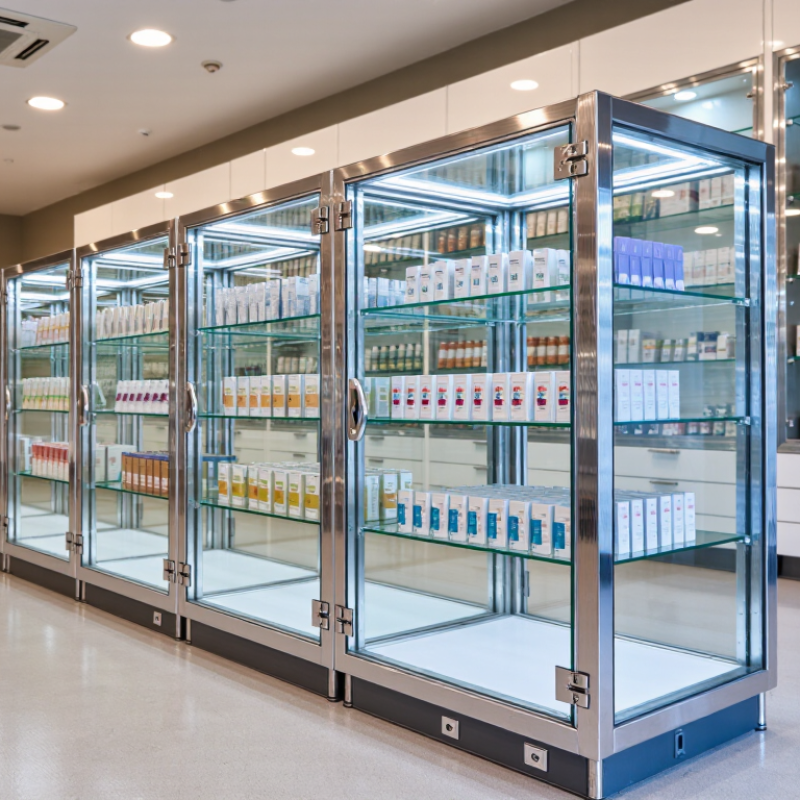
Define Product, Space, and Security Requirements
Choosing a dispensary display case starts with the product, not the furniture. List each item’s dimensions, weight, packaging, lighting needs, and handling frequency. Small packaged goods need shallow, adjustable shelves. Fragile items need padded surfaces and limited access. Measure twice. I still get this wrong sometimes when future inventory is ignored.
Space determines daily usability. Record wall lengths, door swings, queue paths, and staff sightlines before ordering. Keep customer movement comfortable and protect accessible routes. The U.S. Access Board recommends a 36-inch minimum clear width for many accessible routes. Treat that as a starting point, not a complete design solution. Leave room for turning, cleaning, and restocking. The National Retail Federation’s 2023 National Retail Security Survey reported average retail shrink of 1.44% in 2022, representing approximately $112.1 billion in losses. A crowded layout can create blind spots and invite handling errors.
Security should match risk without making the store feel hostile. Consider laminated glass, concealed hinges, controlled locks, anchored bases, and adjustable internal dividers. High-value products deserve better sightlines and restricted staff access. Cameras should capture faces, hands, and transaction areas without glare from case lighting. The Loss Prevention Research Council consistently emphasizes layered protection, combining design, technology, and trained employees. That combination matters more than one expensive lock. Test the case during busy periods. Doors may block queues, reflections may hide labels, and staff may avoid awkward storage. Fix those weaknesses before installation.
10 Tips for Choosing Dispensary Display Cases
Product, space, and security requirements ranked by practical selection priority.
Security and product visibility receive the highest planning scores because display cases must protect regulated merchandise while allowing customers to view products clearly. Space efficiency, lighting, accessibility, durability, maintenance, temperature control, installation, flexibility, and budget should then be evaluated against the store layout and product mix.
Compare Case Materials, Construction, and Locking Systems
Choosing a dispensary display case starts with materials, not appearance. Tempered or laminated glass gives customers a clear view and better impact resistance. Laminated glass is often preferable where safety is a serious concern. Steel frames provide rigidity, while aluminum reduces weight and resists corrosion. Wood-look panels can improve warmth, but exposed edges may wear faster in busy stores. Inspect the finish under bright light. Small chips often reveal weak preparation.
Construction determines daily reliability. Look for reinforced corners, adjustable shelves, smooth hinges, and concealed fasteners. A case should sit firmly on the floor or connect securely to a wall. Measure door clearance before installation. It sounds obvious. It is often missed. Locking systems deserve equal attention. Mechanical locks are simple and dependable, but key control can become messy. Electronic locks may support individual permissions and access records, yet they need batteries, maintenance, and a backup plan. Choose designs that allow staff to view products without constant unlocking. Test the lock with gloves, during closing hours, and after repeated use. One test is never enough. Check local safety, accessibility, and retail security requirements before purchase. No case is perfect, so record weaknesses and review them with installers and store staff.
Evaluate Visibility, Accessibility, Lighting, and Organization
A good dispensary display case should make products easy to see, reach, and compare. Clear sightlines matter. Keep labels facing customers and avoid crowded shelves. Adjustable glass shelves support different package sizes. Frequently requested items should sit between waist and eye level. This saves time. Leave enough hand clearance for staff to retrieve items safely. Rounded edges and stable doors reduce awkward handling. I have learned that more display space can sometimes create less understanding.
Lighting should reveal color and print without glare. Test each case at opening, midday, and closing. Bright LED strips may create reflections on glass. Neutral, even lighting usually supports better reading. Avoid intense blue tones that make packaging appear distorted. A dark corner can hide a useful label. Use contrast between shelves, labels, and product containers. Accessibility also requires practical spacing. Place cases where customers can pause without blocking traffic. Offer readable labels for people with limited vision, and check viewing angles from seated height.
Organization should follow a clear system, such as product type, size, or intended use. Use dividers to prevent packages from leaning or sliding. Keep older stock visible for proper rotation by trained staff. A simple shelf map helps employees restock accurately. Do not depend on appearance alone. A layout can look polished and still confuse visitors. Ask staff to observe repeated questions during busy periods. Reconsider the arrangement when those questions reveal missing information. Real-world testing matters.
10 Tips for Choosing Dispensary Display Cases? - Evaluate Visibility, Accessibility, Lighting, and Organization
| No. | Evaluation Dimension | Practical Recommendation | Useful Benchmark | Why It Matters | Priority |
| 1 | Front-Side Visibility | Choose clear, low-distortion panels and keep the primary product area unobstructed by excessive framing or hardware. | Use transparent panels with clear sightlines from normal customer viewing areas. | Customers can compare products more easily when labels and packages remain visible without opening the case. | High |
| 2 | Viewing Height and Angle | Select shelving and case heights that place key products near the customer’s natural viewing level. | Keep frequently compared items between approximately 90 and 150 cm above the finished floor. | A comfortable viewing angle reduces bending, reaching, and repeated requests for staff assistance. | High |
| 3 | Customer Accessibility | Provide adequate aisle clearance and avoid placing cases where doors, counters, or displays block customer movement. | Maintain at least 91 cm of clear accessible route width where accessibility requirements apply. | Clear routes support safer browsing and help accommodate mobility devices and busy customer traffic. | High |
| 4 | Locking and Staff Access | Use secure locks that staff can operate quickly while keeping displayed products protected from unauthorized access. | Test the lock and access procedure repeatedly before installation and during daily opening routines. | A reliable access system supports security without creating long service delays. | High |
| 5 | Lighting Quality | Choose even, glare-controlled lighting that makes packaging and product information easy to read. | Consider LED lighting with a color temperature around 3,000–4,000 K and a high color-rendering rating. | Balanced lighting improves color recognition while reducing harsh shadows, reflections, and eye strain. | High |
| 6 | Heat and UV Management | Select energy-efficient lighting and materials that limit heat buildup and protect packages from unnecessary light exposure. | Use low-heat LED fixtures and avoid direct sunlight on products whenever possible. | Lower heat and UV exposure can help preserve packaging appearance and reduce maintenance needs. | Medium |
| 7 | Product Organization | Group products by clear categories such as format, intended use, or product strength, and use consistent shelf labels. | Allow enough shelf space to read labels without moving neighboring packages. | Logical grouping shortens search time and makes inventory checks more consistent. | High |
| 8 | Adjustable Layout | Use movable shelves, dividers, and risers so the case can accommodate different package sizes and seasonal assortments. | Prefer tool-free or quick-adjust shelf systems where frequent resets are expected. | Flexible interiors reduce wasted space and delay the need for replacement fixtures. | Medium |
| 9 | Cleaning and Maintenance | Choose smooth, nonporous surfaces with limited seams and easily removable components for routine cleaning. | Check that glass, handles, hinges, locks, and lighting covers are reachable for regular inspection. | Easy maintenance keeps the display presentable and helps identify damaged hardware promptly. | Medium |
| 10 | Capacity and Future Growth | Balance display capacity with available floor space, leaving room for labels, price information, and safe product handling. | Plan for usable capacity rather than filling every shelf; keep products easy to identify and retrieve. | A realistic capacity plan prevents clutter and supports assortment changes without compromising visibility. | High |
Assessment note: Confirm local accessibility, safety, security, electrical, and retail-display requirements before purchasing or installing a display case.
Check Compliance, Customization, Installation, and Maintenance
10 Tips for Choosing Dispensary Display Cases
Choosing a dispensary display case is not only a design decision. Compliance should guide every measurement, lock, label, and viewing angle. Confirm local requirements for secure storage, customer access, accessibility, ventilation, and emergency clearance. Ask for documented safety glass ratings and locking performance. Rules can change. Written confirmation is safer than a confident sales promise. Select surfaces that are easy to sanitize and resist scratches from daily use.
Customization should solve a real operating problem. Adjustable shelves can fit different package sizes without wasting vertical space. Lighting should show colors accurately, avoid glare, and prevent unnecessary heat. Request a sample layout with shelf heights, cable routes, and staff sightlines. Small details matter. However, too many drawers or decorative panels may slow service. A polished case can still fail when employees cannot reach the rear shelf comfortably. That weakness is easy to miss in a showroom.
Installation requires level flooring, reliable anchoring, safe wiring, and clear door movement. A qualified technician should check wall strength and electrical connections before final placement. Leave enough room for cleaning tools and customer movement. Maintenance should include weekly lock, hinge, light, seal, and glass inspections. Use a nonabrasive cleaner and record every defect. Do not rely on memory. Replace damaged components promptly, especially cracked glass or loose hardware. A maintenance log may seem excessive, yet it reveals repeated problems before they interrupt operations.
Assess Pricing, Warranty, and Long-Term Business Value
A display case is not just a furniture purchase. It affects security, presentation, maintenance, and daily staff work. In regulated retail, compare the complete cost, not only the invoice. Include delivery, installation, lighting, lock replacement, cleaning, and future glass repairs. The National Retail Federation’s 2023 National Retail Security Survey reported a 93% increase in shoplifting incidents since 2019. That finding makes strong locks, laminated glass, and controlled access practical investments.
Ask what the warranty actually covers. A five-year frame warranty may exclude hinges, LED drivers, locks, labor, or accidental damage. Request the terms in writing. I have seen buyers accept a low quote, then discover that a failed light requires a costly service visit. That is where estimates fail. Compare response times, replacement-part availability, and whether local technicians are trained for the case system. UL safety certification and documented electrical testing also support a more reliable purchasing decision.
Long-term value should be measured against store traffic and staff time. A case that opens smoothly can reduce repeated handling during busy hours. Adjustable shelves may prevent a remodel when inventory changes. The U.S. Bureau of Labor Statistics reported a 4.1% annual increase in the Producer Price Index for repair and maintenance services in 2023, reminding buyers that service costs can rise. Still, expensive does not always mean durable. Inspect hinges, seals, cable routing, and glass edges personally. Take photographs before signing. Real-world wear is rarely shown in a sales brochure.