


Our new Sales Gallery is located adjacent to our workshop in the Brooklyn Navy Yard. We are on the 6th floor of Building 280. Building 280 is right inside of the entrance at Flushing Avenue and Cumberland Street.

Please contact us to send an entry pass to your smartphone. Send request to [email protected] or call 212 620 4682. You can also register for a pass online.

China Top 10 Egg Packaging Machine Manufacturers

Choosing the right Egg Packaging Machine requires more than comparing factory prices or advertised speed. China’s leading manufacturers serve farms, cooperatives, food processors, and export-oriented packing centers. Their equipment may handle washing, grading, counting, tray loading, carton sealing, and date coding. Each stage affects shell cleanliness, breakage rates, labor needs, and final presentation.

Moba Group CEO Koen de Heus has expressed a practical industry principle: “Egg handling must protect both product quality and producer efficiency.” That idea provides a useful lens for this China Top 10 Egg Packaging Machine Manufacturers overview. Reliable suppliers should demonstrate engineering experience, stable machine performance, responsive service, and compliance with applicable food-contact and workplace-safety requirements. Factory testing matters. So does the detail hidden behind a brochure.

Look closely at stainless-steel contact surfaces, conveyor transitions, sensor accuracy, and reject systems. A poorly aligned transfer point can create hairline cracks during a busy shift. A clear touchscreen can reduce training time for new operators. Remote diagnostics may shorten downtime, but they cannot replace skilled technicians. This is where many rankings become imperfect. A manufacturer may excel at compact machines, while another serves high-capacity industrial lines. Neither is automatically best for every buyer. Production volume, egg size, packaging format, available floor space, and local support should shape the final decision. This guide compares manufacturers through those practical factors, using technical evidence where available and acknowledging areas that require direct verification. Real performance is measured on the factory floor. Not only on paper.
China Top 10 Egg Packaging Machine Manufacturers

What Are Egg Packaging Machines and How Do They Work?

Egg packaging machines automate the careful movement of eggs from grading to retail cartons. FAOSTAT recorded more than 90 million tonnes of hen eggs worldwide in 2022. That volume demands speed, but speed cannot replace gentle handling.

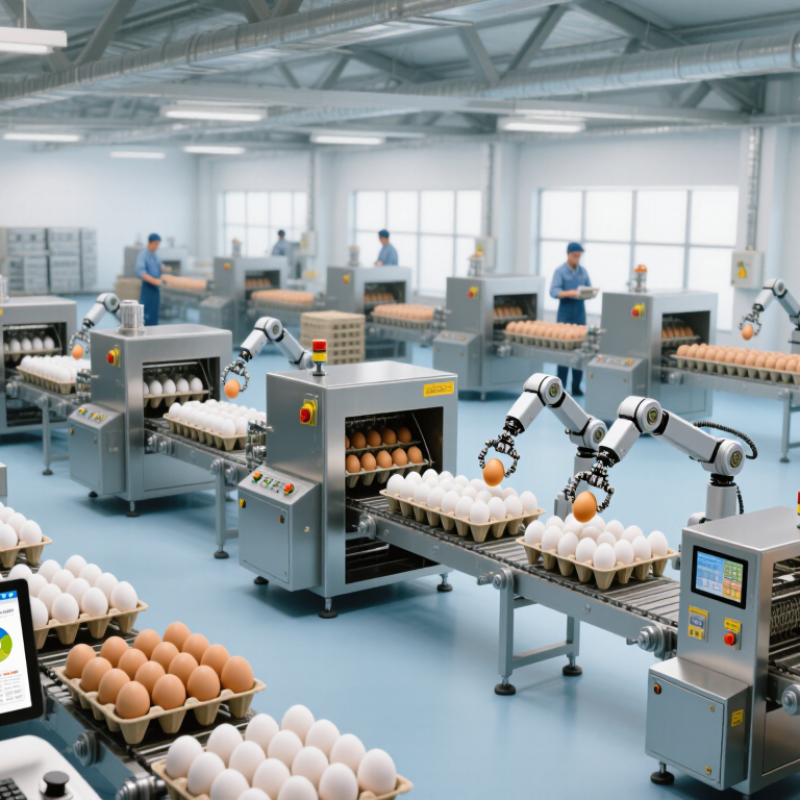
A typical line uses conveyors, candling cameras, weighing systems, and robotic packers. Candling checks shells for cracks or internal defects. Load cells separate eggs by weight class. Soft cups then guide each egg into a carton without sudden drops. Sensors detect missing eggs and stop the line when alignment fails. A sealing unit closes the carton, while printers add dates and traceability details. USDA Agricultural Marketing Service guidance emphasizes candling, weight classification, and defect inspection during official egg grading. Machines follow these principles, although settings still need human judgment.

Tips: Match the machine with egg size, carton design, and daily output. Keep transfer points clean and inspect suction cups each shift. A tiny sensor delay can create a long queue. Operators should test fragile or uneven shells before full production. No machine is perfect; excessive speed may increase cracks, wasted cartons, and customer complaints. That trade-off deserves regular review.

China Top 10 Egg Packaging Machine Manufacturers — What Are Egg Packaging Machines and How Do They Work?

Egg packaging machines transfer, orient, inspect, count, and place eggs into cartons, trays, or cases. The following chart shows representative operating throughput ranges for common machine configurations. Actual capacity depends on egg size, package format, inspection requirements, and line layout.

In a typical line, eggs are collected from the grading system, aligned into lanes, checked for defects, and loaded into packaging containers. More automated systems generally achieve higher throughput while requiring synchronized conveyors, sensors, and control systems.

How China’s Egg Packaging Machine Industry Has Developed

China’s egg packaging machine industry has moved from basic mechanical handling toward integrated, automated production lines. Early equipment often depended on manual loading, simple conveyors, and visual checking. Today, many factories use servo motors, electronic grading systems, and programmable controls. These changes improve speed while reducing cracked eggs during transfer.

Domestic demand helped drive this development. Large farms needed machines that could handle thousands of eggs each hour. Smaller farms also wanted compact equipment with easier maintenance. Stainless steel frames, washable surfaces, and food-grade contact parts became more important. Operators now expect machines to connect grading, counting, packing, and date coding in one workflow.

Export requirements have also influenced design. Manufacturers increasingly adjust voltage, carton sizes, safety systems, and documentation for different markets. Some equipment can record production data and identify irregular egg sizes. Useful, but not perfect. Data systems may still be difficult for smaller plants to manage. After-sales training can also vary between suppliers. In practice, buyers should inspect cleaning access, spare-part availability, noise levels, and real operating capacity rather than trust a brochure alone. The industry is advancing quickly, yet reliable engineering still depends on careful testing and honest communication.

Criteria for Selecting China’s Top 10 Manufacturers

Selecting China’s top 10 egg packaging machine manufacturers requires more than comparing prices or showroom photos. FAO’s 2023 Statistical Yearbook recorded global hen-egg production above 86 million tonnes in 2021, showing the scale behind modern packing demand. A credible manufacturer should demonstrate stable performance under this pressure. I would examine throughput, egg breakage, grading accuracy, and changeover time. Factory acceptance tests should use the buyer’s egg sizes, trays, and operating conditions.

Automation matters, but practical reliability matters more. The 2024 PMMI packaging report identifies labor efficiency and automation as major investment drivers. Therefore, strong candidates should offer automatic feeding, visual inspection, tray loading, and production data tracking. Ask for documented uptime, maintenance intervals, energy consumption, and spare-parts availability. Short trials help.

Do not trust claims alone.

A useful audit should include production records, quality certificates, electrical safety documentation, and customer references from comparable farms or packing centers. Engineers should inspect washdown areas, guarding, sensors, and software access. After-sales response also deserves measurable terms, such as remote support time and technician availability. Public failure statistics are still limited, which makes supplier comparisons imperfect. That gap should be admitted, not hidden. The final shortlist should reward verified field experience, transparent testing, and lifecycle value rather than impressive brochures.

China’s Top 10 Egg Packaging Machine Manufacturers

China’s Top 10 Egg Packaging Machine Manufacturers are often compared by machine stability, production capacity, and service quality. A reliable supplier should offer clear specifications, factory testing, and practical installation support. Egg packaging equipment must handle fragile shells without creating excessive breakage. Smooth conveyors, adjustable rollers, and accurate counting systems matter greatly.

In real purchasing projects, buyers should inspect sample packaging before signing a contract. Ask for running videos, maintenance records, and spare-parts lists. Food-contact materials should be easy to clean and suitable for hygienic production environments. Electrical systems also require clear safety documentation and dependable technical support. Some quotations look attractive but exclude installation or operator training. That can become expensive later. I have found that transparent communication is often more valuable than a low initial price.

Tips: Compare the same technical details across all ten manufacturers. Check speed, egg size range, tray compatibility, power consumption, and warranty terms. Request a test using your own trays and eggs. Observe alignment, noise, and rejected products. Small problems appear quickly. Do not rely only on catalog photos; they may hide outdated designs or difficult cleaning areas. A supplier that admits equipment limits may deserve more trust than one promising perfect performance. Consider local service response times, because a stopped packaging line can affect daily deliveries.

How to Compare Suppliers, Technologies, and After-Sales Support

China Top 10 Egg Packaging Machine Manufacturers

Comparing China’s top egg packaging machine manufacturers requires more than checking catalog prices. Ask for a live production test using your egg sizes, tray materials, and target speed. Observe the transfer point closely. Misaligned fingers, sudden stops, or cracked shells reveal more than a polished video.

Evaluate technology through measurable results. Check output per hour, breakage percentage, electrical consumption, and changeover time. Servo-driven systems may improve positioning, while pneumatic parts can simplify maintenance. However, advanced controls are not automatically better. Request wiring diagrams, spare-parts lists, and software access before signing a contract. A machine running at 30,000 eggs per hour may perform poorly with uneven farm eggs.

After-sales support often separates dependable suppliers from temporary sellers. Confirm installation training, remote response time, warranty coverage, and technician availability in your region. Ask whether support includes troubleshooting by video, replacement-part identification, and operator training. During factory visits, inspect assembly areas and test records, not only the showroom. A clean showroom proves little. I have seen impressive demonstrations hide difficult cleaning routines and unclear maintenance duties. That deserves reflection. Require references from comparable farms, then contact them directly. Keep acceptance criteria in writing, including noise limits, safety guarding, delivery documents, and actual breakage results. A low quotation can become expensive when downtime, custom parts, and delayed support enter the calculation.

China Top 10 Egg Packaging Machine Manufacturers - How to Compare Suppliers, Technologies, and After-Sales Support

The supplier identities are intentionally omitted. The comparison below uses commonly published specifications, standard machine configurations, and practical procurement criteria for egg packaging equipment in China.

Supplier Profile Main Technology Typical Capacity Compatible Packaging Automation Level Changeover and Control After-Sales Support to Verify Best-Fit Buyer
01 Manual tray loading with automatic counting 500–1,500 eggs/hour 30-egg pulp or plastic trays Semi-automatic; operator loads trays and cartons Basic sensor control; simple mechanical adjustment Remote troubleshooting, spare sensors, operating manual Small farms and local packers
02 Automatic tray filling and carton loading 1,500–3,000 eggs/hour 6-, 10-, 12-, 15-, and 30-egg formats Automatic feeding with manual product inspection Touchscreen interface; recipe-based settings Installation guidance, video training, one-year warranty commonly offered Growing commercial packers
03 High-speed roller or conveyor packaging line 3,000–6,000 eggs/hour Pulp trays, plastic trays, and retail cartons Continuous automatic conveying and packing PLC control, photoelectric sensors, emergency-stop circuits Commissioning support, electrical drawings, preventive-maintenance schedule Medium-scale processing plants
04 Egg grading and packaging integration 4,000–8,000 eggs/hour Weight-graded cartons and trays Automatic weighing, sorting, and packing Multiple grading channels; programmable weight classes Calibration instructions, replacement load cells, technician training Producers selling by weight grade
05 Vision inspection with reject mechanism 3,000–6,000 eggs/hour Retail cartons and protective trays Automatic surface inspection and defective-egg rejection Camera-based inspection; adjustable rejection parameters Camera calibration, software backup, remote diagnostics Premium retail and export packers
06 MAP or modified-atmosphere carton line 1,000–3,000 cartons/hour Sealed retail cartons and lidded packs Automatic filling, gas flushing, sealing, and coding Gas-flow control, sealing-temperature monitoring, date coding Seal-quality testing, gas-system maintenance, operator certification Extended-shelf-life products
07 Robotic case packing and palletizing 6,000–12,000 eggs/hour Cartons, trays, cases, and pallets Integrated robotics with conveyor tracking Robot safety fencing, interlocks, pallet recipes Robot programming backup, safety inspection, spare grippers Large distribution centers
08 Custom export line with multilingual controls 2,000–8,000 eggs/hour Customer-specific trays, cartons, and case sizes Configured to the buyer’s layout and packaging standards Multilingual HMI, layout simulation, customized recipes Factory acceptance testing, shipping documents, remote commissioning International buyers
09 Compact modular packaging system 1,000–4,000 eggs/hour Interchangeable trays and cartons Expandable modules for filling, labeling, and coding Quick-release tooling; manual or automatic adjustments Module replacement, upgrade roadmap, standard spare-parts kit Businesses planning gradual expansion
10 Turnkey washing, grading, packing, and logistics line 8,000–15,000 eggs/hour Trays, cartons, cases, labels, and pallet loads Fully integrated processing and end-of-line automation Central PLC, production data collection, line-status monitoring Project management, FAT/SAT testing, training, service-level agreement Industrial egg-processing facilities
Capacity Check
Confirm whether the quoted output is based on eggs per hour, cartons per hour, or trays per hour, and request a production test using the buyer’s egg sizes and packaging materials.
Technology Check
Compare actual changeover time, reject accuracy, egg-breakage rate, sensor availability, energy consumption, and compatibility with local electrical standards.
Service Check
Request warranty terms, response time, spare-parts availability, remote-support procedures, installation scope, training hours, and acceptance-test documents.