


Choosing the best Car Rooftop Tent depends on how you travel, where you camp, and what your vehicle can safely carry. Rooftop tents generally fall into three types: soft-shell, hard-shell, and hybrid designs. Each offers a different balance of setup time, sleeping space, packed size, and cost. A soft-shell tent often opens into a broad sleeping area, while a hard-shell model usually packs into a compact shell and can be quicker to deploy. Hybrid designs combine features of both, though their benefits vary by model. There is no perfect type for every trip.
Real-world details matter more than a dramatic product photo. Check your vehicle’s roof-load limits and the rack manufacturer’s specifications before comparing tent weights. Measure the parked vehicle’s height, too; a tent can make garages and low branches a problem. Consider how many people will sleep inside, how often you will move camp, and whether you need room for bedding. Rain protection, ventilation, ladder stability, and condensation control also deserve attention. Small details, like opening the tent in a cold drizzle, can change your opinion quickly.
This guide compares the main rooftop tent types and explains where each tends to work best. It also highlights trade-offs that product descriptions may gloss over. A fast setup is useful, but it does not guarantee comfort. A roomy tent may be awkward to store or handle. Use the comparisons as a starting point, then verify dimensions, weight, mounting requirements, and care instructions with the manufacturer. Your best choice should fit both your vehicle and your habits—not just the campsite you imagine.
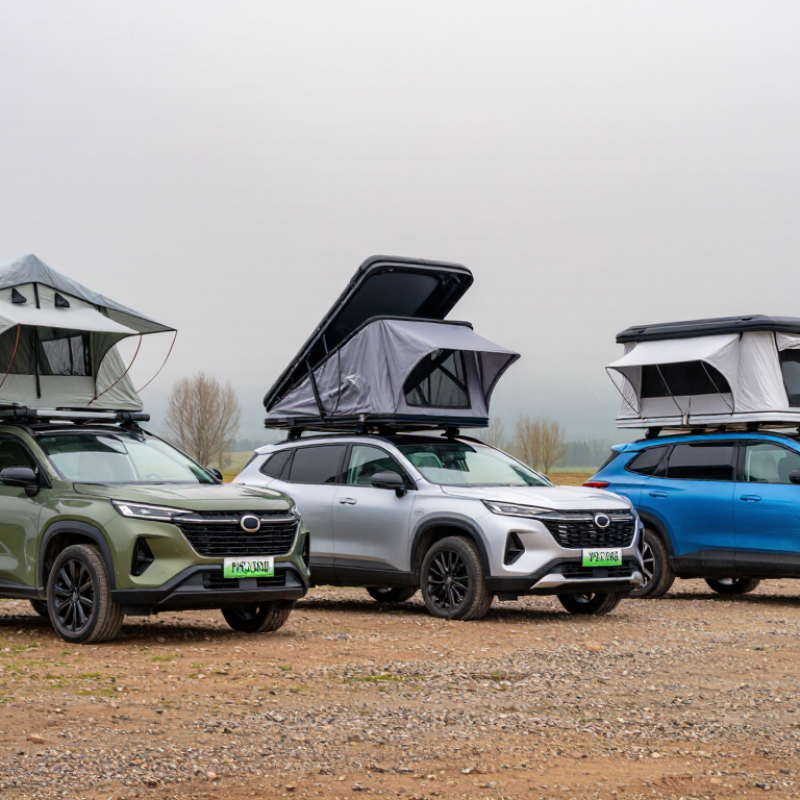
Soft-shell tents use a folding platform and fabric canopy. They often cost less and pack down compactly, but opening and securing the fabric takes time. Hard-shell models use a rigid lid, often with gas struts, for quicker setup and a more enclosed sleeping space. They can weigh more and cost more. Hybrids combine a rigid base or roof with folding fabric walls. They split the difference, though extra hinges and exposed fabric still need care. There is no universal winner.
The Outdoor Industry Association’s 2024 Outdoor Participation Trends Report counted 175.8 million U.S. outdoor participants in 2023. That figure measures outdoor recreation, not rooftop-tent sales, but it shows the broad camping context. For a buyer, the vehicle matters just as much as the tent: check its dynamic roof-load limit for travel and the tent maker’s guidance for parked use. A simple category ranking can mislead. One rainy night may change your priorities.
Tips: Try the opening mechanism before buying. Check before buying. Compare packed height, weight, and mattress size, then picture the tent above your own vehicle. I would not choose by shell type alone; the right compromise may still feel inconvenient in real weather.
The best rooftop tent is not always the largest; setup time, packed dimensions, and sleeping capacity determine how practical it feels at camp.
The Outdoor Industry Association’s 2024 Outdoor Participation Trends Report estimates that 175.8 million Americans took part in outdoor recreation in 2023. That broad participation figure signals a large audience, but it does not measure tent performance. Compare actual product specification sheets instead.
Hard-shell models commonly list setup times of roughly one to three minutes, while soft-shell designs may need five to ten minutes, including ladder and rainfly adjustments. Treat these as manufacturer claims, not independent test results.
A tall or wide shell can block a garage, add wind resistance, or crowd roof accessories. Check length, width, and closed height, then compare them with your vehicle’s roof-rack limits.
For capacity, a two-person rating may mean two adults fit closely, not comfortably with bags. Three- and four-person models offer more floor space but usually take up more roof area. Check sleeping-area dimensions, not just the advertised headcount.
Tiny differences matter. A few centimeters can decide whether bedding stays inside during travel.
Manufacturer methods also vary, so setup-time claims are not perfectly comparable; wind, cold fingers, and an uneven campsite can slow even a quick-folding tent.
The best rooftop tent is one your vehicle can safely carry while moving. Check the owner’s manual for its rated dynamic roof load. This limit applies on the road, not while parked. Include the weight of the tent, roof rack, mounting hardware, and any accessories. A tent that seems light can push the total over the limit once the rack is counted. That detail is easy to miss.
Tips: Weigh the full setup if possible. Compare it with both the vehicle’s roof-load rating and the rack’s rating. Use the lower limit. Leave a margin for gear, and recheck fasteners after installation.
A parked vehicle can usually support more weight than a moving one, but do not assume a specific allowance without checking the manufacturer’s guidance. Braking, cornering, and rough roads can add forces to the roof system. Keep heavier items low and secure; avoid placing loose gear inside the tent for travel. If the numbers are close, choose a lighter tent or rack. I would rather sacrifice a little sleeping space than guess at the limit. A small mismatch can matter.
Soft-shell rooftop tents usually rely on coated woven fabric, while hard-shell models often use a rigid roof and fabric sidewalls. Denier describes yarn linear density: ASTM D1907 defines it as grams per 9,000 metres of yarn. A 300D fabric uses heavier yarn than a 150D fabric, but denier alone cannot predict tear strength or waterproofness. Weave, coating, and construction matter too. Heavier fabric can feel reassuring, yet it may add weight to a roof-mounted setup.
For rain protection, compare hydrostatic-head ratings, measured in millimetres of water. ISO 811:2018 specifies a hydrostatic-pressure test for determining when water penetrates a textile specimen. It defines a test method, not a universal “tent-grade” threshold. A higher reported value indicates greater resistance in that test, but seams, zippers, and wear can still let rain through. Check whether the rating applies to the finished fabric or only a laboratory sample. The distinction is easy to overlook. A 1,500 mm rating and a 3,000 mm rating are useful comparison points, not guarantees of dry bedding in prolonged storms. ASTM D1907 and ISO 811 help clarify what is being measured; neither replaces checking seam design and care instructions.
| Rooftop Tent Type | Typical Textile Construction | Typical Denier or Fabric Weight | Commonly Published Hydrostatic-Head Range | Practical Strengths | What to Check Before Buying |
|---|---|---|---|---|---|
| Soft-shell fold-out | Coated polyester, polycotton canvas, or a combination of a coated fly and canvas body | Often around 600D for polyester fabrics; polycotton is more commonly specified by fabric weight, such as roughly 280–420 g/m², rather than denier | About 1,500–3,000 mm is commonly specified for tent fabrics; higher figures are available | Large sleeping area for its packed footprint; many layouts can accept an annex | Check whether the stated rating applies to the fly, the main body, or both. Canvas weight in g/m² is not directly comparable with polyester denier. |
| Hard-shell pop-up | Fabric sidewalls, commonly polyester or polycotton; the rigid shell is a separate component and is not measured in denier | Fabric specifications vary; polyester may be listed by denier, while polycotton is usually listed by weight in g/m² | Where a fabric rating is provided, roughly 1,500–3,000 mm is a common published range | Fast setup and pack-down; the closed shell protects the folded tent fabric | Confirm the rating for the exposed fabric panels and seams. A rigid shell does not establish the waterproof rating of the fabric. |
| Hard-shell clamshell | Fabric walls and, on some designs, a fabric-covered extension; roof and base may be rigid panels | Product-specific; fabric may be stated in denier or g/m² depending on material | Often around 1,500–3,000 mm when a textile hydrostatic-head specification is published | Quick deployment and a compact closed profile; some designs provide a longer sleeping platform | Ask which textile components were tested and whether the rating was measured using ISO 811 or another method. |
| Rooftop tent with an annex | Main tent fabric plus additional annex walls; materials and coatings can differ between the two | Varies by component; denier alone does not show coating quality, seam construction, or fabric weight | Check separate figures for the tent body and annex; published values commonly fall around 1,500–3,000 mm for tent textiles | Adds sheltered living or storage space, especially at a campsite | Do not assume the annex shares the main tent’s waterproof rating. Check its floor, zippers, seams, and coverage. |
How to compare: Denier (D) describes the linear mass of yarn, not waterproofness or overall fabric strength. Hydrostatic head is the water pressure a fabric withstands in a test; ISO 811 specifies a method for determining resistance to water penetration. Ratings are not universal by tent type, and results can depend on the tested fabric, coating, seams, and test conditions. Compare figures only when the tested component and test method are stated.
For touring, a low-profile hard-shell tent suits frequent stops and quick setup. Check its closed height against garages, branches, and parking structures. A few centimeters can matter. The Outdoor Industry Association’s 2024 Outdoor Participation Trends Report counted 175.8 million U.S. outdoor participants in 2023, underscoring how many people use outdoor gear across varied trips. That figure does not identify rooftop-tent demand, but it supports choosing for your actual travel pattern, not a showroom impression.
Family camping usually favors a wider soft-shell tent, especially when children need room to change or sleep. Compare the usable mattress area, ladder position, and setup steps before buying; advertised capacity can feel optimistic with bulky bedding. KOA’s 2024 North American Camping Report estimated that about 57 million U.S. households camped in 2023. More campers do not automatically mean more space is better. Check your vehicle’s roof-load limits, including the tent, occupants, and moving loads.
For cold-weather travel, prioritize a well-insulated floor, dependable ventilation, and a rainfly that keeps fabric away from sleeping bags. A hard shell may reduce setup time, but it does not guarantee warmth. Condensation still happens. Match insulation and sleeping gear to expected overnight temperatures, and test the arrangement close to home before a remote trip. One overlooked detail: a warm tent can still feel miserable if cold air enters around the ladder opening.